

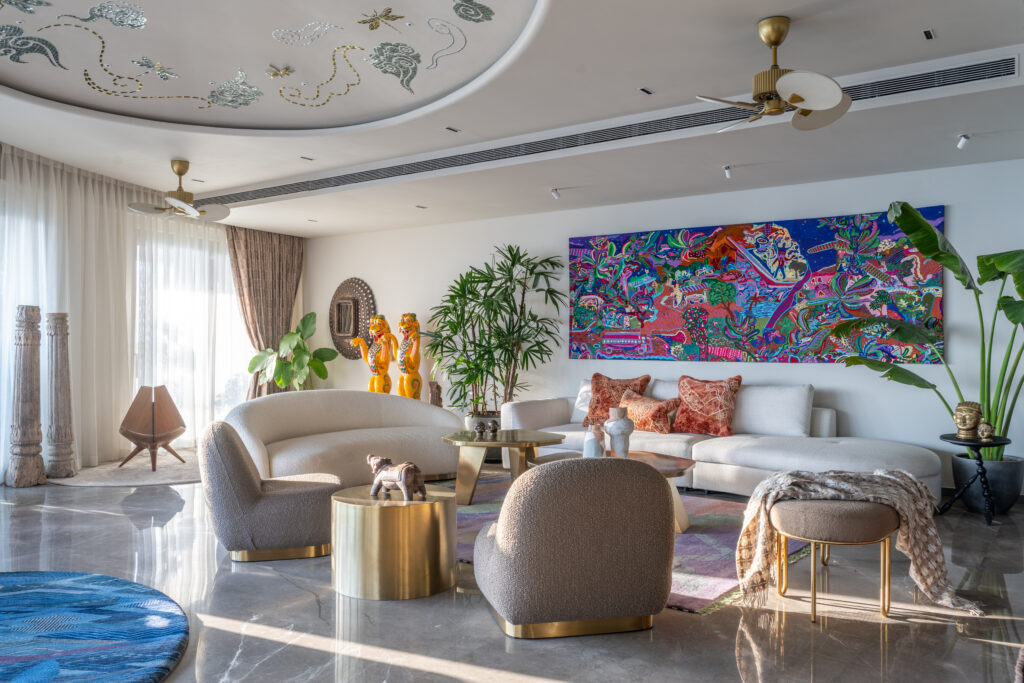
There’s a moment that happens in well-designed spaces. A guest walks in, stops, and says, what is that?
Not because the piece is flashy. Because it pulls at something they can’t quite name.
That’s what bespoke art does. And it’s something a print from a furniture catalogue will never replicate, no matter how expensive the frame.
What Emotional Value Actually Means in Interior Design
Emotional value isn’t a soft concept. It’s measurable in how long people linger, how often they reference a space in conversation, and, for commercial clients, how a space affects brand perception and client retention.
Bespoke art creates emotional value through three specific mechanisms:
- Narrative specificity. A piece commissioned for a particular client, space, or story carries meaning that’s embedded in its creation. The materials, the scale, the subject, all of it was decided for this place. That intentionality reads, even to people who don’t know the backstory.
- Scale and spatial dialogue. Custom art is designed for its wall, its light, its sight lines. Mass-produced work is designed for a warehouse shelf. The difference in how a space breathes around the two isn’t subtle.
- Irreplaceability. There’s a quiet psychological effect to knowing something exists only here. It turns a room into a destination rather than a backdrop.
The Problem With Decorative Thinking
When art is treated as decor, as something to fill a wall or match upholstery, it becomes invisible. Not physically, but perceptually. The eye moves past it. The brain categorizes it as wallpaper.
This is the ceiling of mass-produced art. Even a technically beautiful print loses its weight when the same piece is hanging in three hotel lobbies and a dentist’s waiting room.
Bespoke art resists this categorization. It demands to be seen because it was made to be seen, in that room, at that scale, for that person.
High-end bespoke residential clients understand this intuitively. They spend months on a kitchen, agonize over plaster finishes, and source bespoke furniture, then drop a generic canvas on the feature wall and wonder why the room doesn’t feel finished. The art is the last five percent that’s actually forty percent of the feeling.
What Bespoke Art Communicates About a Space (and Its Owner)
Walk into a room with a commissioned piece and art that was clearly chosen with intention, and you get an immediate read on the person who lives or works there: someone who thinks in layers, who isn’t decorating for approval, who cares about experience over trend.
That signal matters in residential design. It matters even more in commercial contexts, hospitality, corporate, retail, where a brand is being constructed through every material choice in the room.
The best bespoke art programs we’ve worked on have a brief behind every piece. Not a vague mood board, but a considered answer to: What do we want someone to feel 30 seconds after they walk in? That question produces very different results than: What colour matches the sofa.
How Custom Art Holds Value Over Time
Decorating trends turn. The neutral palette that felt calm in 2019 felt dated by 2023. Art tied to trend cycles ages with them.
Bespoke art, made with genuine craft and conceptual depth, doesn’t. It may go in and out of cultural fashion, but it retains its identity. It has a reason for existing beyond trend compliance.
For clients treating interiors as long-term investments, which, at the high end, they always are, this distinction is material. The custom piece will still be the most interesting thing in the room in fifteen years. The mass-produced alternative will be in storage by then.
Working With Artists vs. Selecting Art
There’s a meaningful difference between selecting existing art and commissioning it. Both have their place, but the commissioning process itself has value.
When a designer or client works directly with an artist, sharing the architecture, the brief, the intended emotional register of a space, the resulting piece carries that collaboration. The artist solves problems the designer couldn’t anticipate. The designer brings constraints that push the work somewhere it wouldn’t have gone independently.
This is why bespoke art programs aren’t just an aesthetic choice. They’re a design process, one that produces results neither party could achieve alone.
The Practical Question: Is It Worth the Investment?
For a mid-range interior, probably not. The economics don’t work, and the audience won’t feel the difference.
For a high-end project, one where the whole brief is to create a space that feels genuinely considered, the question inverts. Can you afford not to?
The rooms people remember, that they photograph, that they bring friends back to see, that they describe years later in conversation, have a piece of bespoke art in them more often than not. Not always. But enough that it’s not a coincidence.
FAQ
1. What makes art bespoke rather than just custom?
Bespoke implies a process, not just a product. It’s art developed in direct response to a specific space, client, and brief, not a generic piece adapted to a new size. The distinction is between something made for you and something made to order.
2. How early in a project should bespoke art be commissioned?
Ideally at the design development stage, not at the end. Art commissioned late gets treated as decoration. Art commissioned early can inform spatial decisions, proportion, material, light. That integration is where the real value comes from.
3. Does bespoke art require a large budget?
Not necessarily. The investment is less about total spend and more about intent. A single well-commissioned piece, developed properly with the right artist, can anchor a room more effectively than a wall of expensive framed prints.
4. How do I brief an artist for a commissioned piece?
Start with what you want the room to feel, not what you want the piece to look like. Share the architecture, the materials, the client. Let the artist bring their own interpretation within those parameters. Briefs that over-specify aesthetics tend to produce technically correct work that lacks life.