

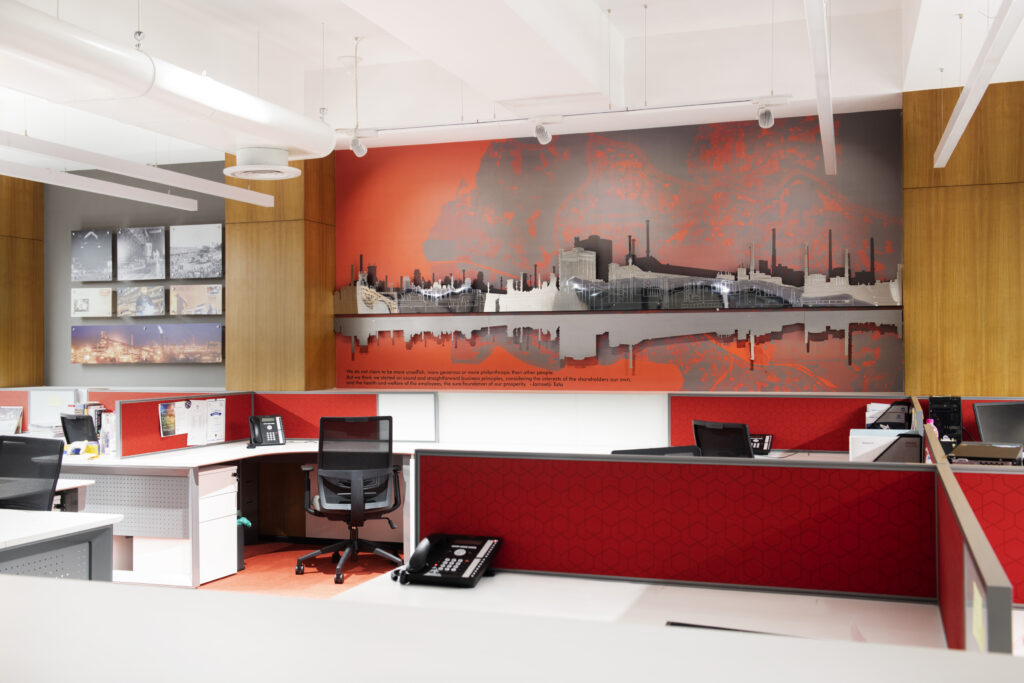
A Bengaluru tech company spent six months and significant money redesigning their headquarters. Beautiful space, open plan, natural materials, good light. Their employees’ first response when they saw it? ‘It looks like every other tech office.’
They’d done everything right, materially. But they’d missed the thing that makes a space distinctive rather than just well-executed.
They called us three months later.
The Sameness Problem in Commercial Design
If you’ve visited a dozen corporate offices in India’s major cities in the last five years, you’ve probably noticed they’re starting to look alike. Exposed concrete. Biophilic elements. Warm wood tones. Lounge areas with curved sofas. Good natural light.
None of this is wrong. All of it is now the baseline.
The companies that are doing something different, the ones whose offices get talked about, visited, photographed, have added an element that can’t be sourced from a catalogue. They’ve commissioned work.
Generic luxury is everywhere. What it doesn’t have is a story. And story is what separates the spaces people remember from the ones they forget the moment they leave.
What Large-Scale Art Actually Does in a Commercial Space
Not mood improvement. Not aesthetic softening. (Though both happen as side effects.) The strategic functions of large-scale art in commercial spaces are specific:
1. It Creates Identity That Can’t Be Copied
If your office could belong to any company in your sector, that’s a brief failure. A bespoke commercial art commission, particularly one that references your company’s actual story, your city, your field, creates something that is, by definition, yours. A competitor can copy your furniture specification. They can’t copy your commissioned work.
2. It Functions as a Retention and Recruitment Tool
This sounds like a reach until you hear it from the people making hiring decisions. In competitive hiring markets, technology, finance, professional services, the quality and identity of the physical workspace is part of the pitch. ‘Come see where you’d be working’ is a real line used in real interviews.
Spaces with genuine character, including landmark art, have an advantage in that conversation that a beer fridge and ping pong table simply don’t.
3. It Marks Territory in Client-Facing Spaces
For companies whose clients visit their offices, law firms, consultancies, financial services, creative agencies, the physical environment is an argument about quality. A reception area with a meaningful, beautifully made large-scale work says something about care and intention that slides in a pitch deck cannot.
This is particularly true with international clients visiting Indian offices. The expectation of what ‘premium’ looks like has been set by the world’s best-designed corporate spaces. Indian companies operating globally are being held to that standard.
Getting the Brief Right: The Questions That Matter
Most commercial art briefs are too vague to be useful. ‘Something that represents our values’ or ‘warm and inspiring’ tells an artist almost nothing. The briefs that produce exceptional work are specific about a narrow set of things:
What’s the exact location, the dimensions, the light, the sight lines, the traffic flow? What will people be doing when they encounter this piece? How long will they have to look at it? What’s the company’s actual story (not the brand guidelines version) the founding, the city, the field, the culture?
The more specific the brief, the better the work. Vague briefs produce generic outcomes.
Medium, Scale, and Why They’re Often Decided in the Wrong Order
The most common mistake in commercial art commissions: the client or designer decides they want ‘a large painting’ or ‘a sculpture’ before thinking about what the work needs to do.
Medium should follow brief, not precede it. A handwoven textile installation in jute and natural dye might be exactly right for a company with a connection to Indian craft heritage. An oxidised metal work with depth and texture might be right for a fintech company that wants to feel grounded rather than cold. A large-scale photography commission might be right for a media organisation.
The medium is the last decision, not the first. But it’s usually the first decision made.
What to Expect from the Commission Process
A properly managed art commission for a commercial space takes time. Usually three to six months from brief to installation for a significant piece. Sometimes more, for complex work.
This is another reason to start early. Art commissioned as an afterthought, briefed three weeks before the office opens, ends up rushed, or misplaced, or both.
The process involves: developing the brief with all stakeholders, identifying the right artist or studio, a concept development phase, approval on designs and materials, fabrication, and installation. Each stage needs time built around it.
That sounds like a lot. It is. It also produces work that people are still talking about ten years later, which is a different outcome from art that was procured in three weeks and ignored in three months.
Interior Designers and Architects: The Case for Bringing Art In Early
If you’re designing a commercial space and you’re not yet thinking about the art brief, this is the conversation to start now.
The spaces that feel complete are the ones where the art was part of the design conversation from the beginning. Where the lighting was designed to serve the work. Where the ceiling height was partly informed by what the installation required. Where the material palette in the surrounding space amplifies rather than contradicts the art.
That’s integration. It’s different from decoration. And it’s worth having the conversation early enough to make it possible.
Designing a commercial space and need to think through the art brief? Or looking to commission a large-scale installation for a corporate or hospitality project? Baayadesign works across India, from brief to installation. info@baayadesign.com