

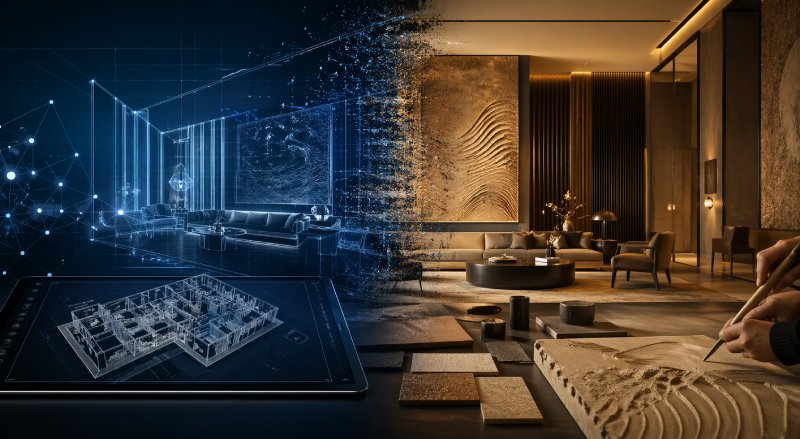
There’s a lot of noise right now about AI and design. Every few weeks, a new tool promises to generate floor plans, suggest colour palettes, or spit out 3D renders in seconds. And honestly? Some of it is genuinely useful.
But here’s the thing , AI is changing how designers work, not what great design actually is.
If you work in architecture, interiors, or bespoke hospitality, this distinction matters a lot.
What AI Is Actually Good At
Let’s be honest about what these tools do well. AI is fast, it can process thousands of reference images, generate mood boards, run lighting simulations, and produce early-stage concepts in a fraction of the time it used to take.
For a studio working on a large hotel project, that speed is real value. You can test 12 spatial configurations before breakfast. You can show a client three completely different vibes for their penthouse before the first proper brief meeting.
So for exploration and iteration, AI has genuinely changed the pace of work.
Where It Falls Short
Here’s the problem, though. AI works from patterns. It learns from what already exists. So when you ask it to generate a “luxury lounge concept,” it pulls from everything it’s ever seen, and gives you something that looks like a composite of every luxury lounge ever photographed.
It’s competent. But it’s not original.
And for clients who want a space that actually says something , about who they are, what their brand means, or how they want people to feel, competent isn’t enough.
A five-star hotel lobby doesn’t need to look like five-star hotels. It needs to look like itself.
The Gap AI Can’t Fill
The real work in spatial design studio has always been interpretation. Understanding a client who says “I want it to feel warm but not heavy” or “sophisticated but approachable.” That’s not a prompt you can type into a tool. It takes conversation, observation, and experience.
And then there’s the making. Custom art installations, bespoke furniture, hand-finished surfaces, site-specific sculptures , these things don’t come from a render. They come from craftspeople, from studios, from a design process that’s deeply human.
AI can show you what something might look like. It can’t make the thing.
The Case for Art That’s Made, Not Generated
There’s a category of work that AI simply can’t replicate , pieces made by hand, in response to a specific place and brief. At Baaya Design, this is what Bespoke by Baaya is built around. Every project starts with the space, the story, and the people , and the outcome is something that couldn’t have come from a prompt.
For projects that need a starting point , a curated range of art concepts, panels, and surfaces that can be adapted to fit , Baaya Signature offers a collection of customisable works across wall art, panels, and art lighting. It’s a middle ground between off-the-shelf and fully site-specific: considered design that can still be tailored to your space.
So What Does This Mean for the Future?
The studios and designers who’ll do the best work in the next decade are the ones who use AI where it helps , exploration, visualisation, documentation , and stay deeply human where it counts: the thinking, the making, and the meaning.
Spaces that feel extraordinary aren’t extraordinary because they were designed efficiently. They’re extraordinary because someone had a clear vision and the skill to bring it to life.
That’s still very much a human job.
If you’re working on a bespoke residential, bespoke hospitality, or bespoke corporate project and want design that goes beyond the template, talk to us. Baaya Design works at the intersection of concept and craft , and we’d love to hear about your space.