

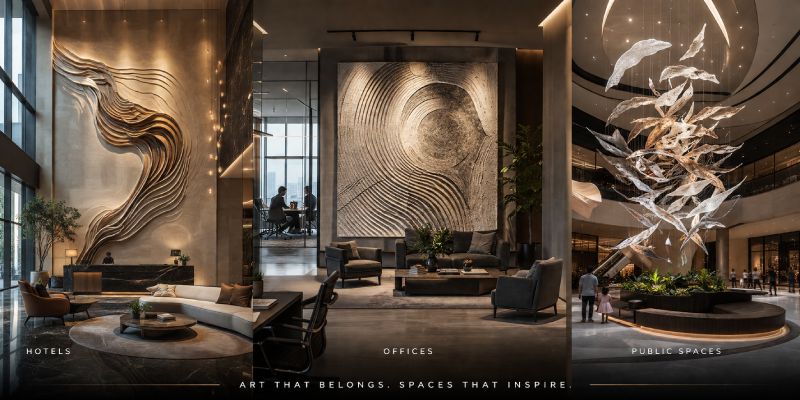
Most spaces use art as decoration. You can tell. The pieces are thoughtful, often expensive, sometimes beautiful , but they sit in the space rather than being part of it. They could be anywhere.
Bespoke art installations work differently. And once you’ve experienced a space where the art was genuinely made for it, the difference is hard to unsee.
Hotels: Where First Impressions Are Everything
In bespoke hospitality, you have about 90 seconds to communicate everything about what kind of place you are. The lobby does more work than any marketing material.
Here’s the thing about generic art in hotel lobbies: it reads as generic. Guests process it immediately and move on. It signals “we spent money on art” rather than “this place has a point of view.”
A site-specific installation , one that responds to the architecture, the location, the story of the property , does something completely different. It creates a moment. People slow down. They look. They take photographs. They mention it to whoever they’re travelling with.
More practically, it becomes part of how the hotel is remembered and described. “The one with the incredible sculpture in the lobby” is a real competitive advantage in a market where every hotel is competing on thread count and bathroom fixtures.
Take Hyatt Regency Dehradun , the installations there were developed in response to the property’s location and character, not sourced from a catalogue. The result is a property that has a visual identity you can feel, not just see. The same is true at Marasa Sarovar Tirupati, where the art connects to the spirit of the place in a way that generic hospitality art simply can’t.
Offices: The Environment Shapes the Work
Corporate spaces have a different brief. Here, art isn’t just about aesthetics , it’s about how a space makes people feel when they spend eight or more hours in it.
There’s real evidence that considered environments improve focus, reduce stress, and support creativity. But more than that, the art and spatial elements in an office communicate something to the people who work there: that the organisation takes their environment seriously, that craft and thoughtfulness are valued.
For a law firm, a financial institution, or a technology company trying to attract serious talent, that signal matters.
A good example of this in practice is IIM Ahmedabad , an institution where the spatial art needed to reflect both intellectual rigour and a sense of place. The commission wasn’t about decorating a building. It was about adding meaning to it.
Art installations in bespoke corporate spaces can do specific work. A large-scale piece in a meeting room can reduce the clinical tension of those spaces. Art in a reception area frames how clients arrive and what they assume about the organisation before a word is spoken.
Public Spaces: The Hardest Brief and the Biggest Impact
Public art has a particular challenge: it has to work for everyone. It can’t be alienating or exclusive, but it also can’t be so safe it becomes invisible.
The installations that work in public spaces, shopping centres, airports, cultural institutions, urban precincts , are the ones that invite people in. That give them something to look at, something to wonder about, something to remember.
They also anchor a place. Good public installations become part of how a neighbourhood or development is identified. They’re what people direct each other toward. That kind of embeddedness takes years to build with generic art, and some pieces never achieve it.
You can browse the full range of Bespoke by Baaya projects to see how this approach plays out across hospitality, institutional, and public contexts , each one started from a real brief, not a product range.
What Makes the Difference
The common thread across hospitality, corporate, and public installations is this: when the art was made for the space, people know it. They might not be able to articulate why, but they feel it.
That’s not mysticism , it’s the result of a process where the studio understands the architecture, the brief, the audience, and the story, and makes something in response to all of it.
Generic art is made for a market. Bespoke art is made for a place.
Baaya Design creates site-specific installations for hotels, corporate spaces, and public environments across India and internationally. If you’re working on a project that deserves more than a catalogue, reach out and tell us about it.