

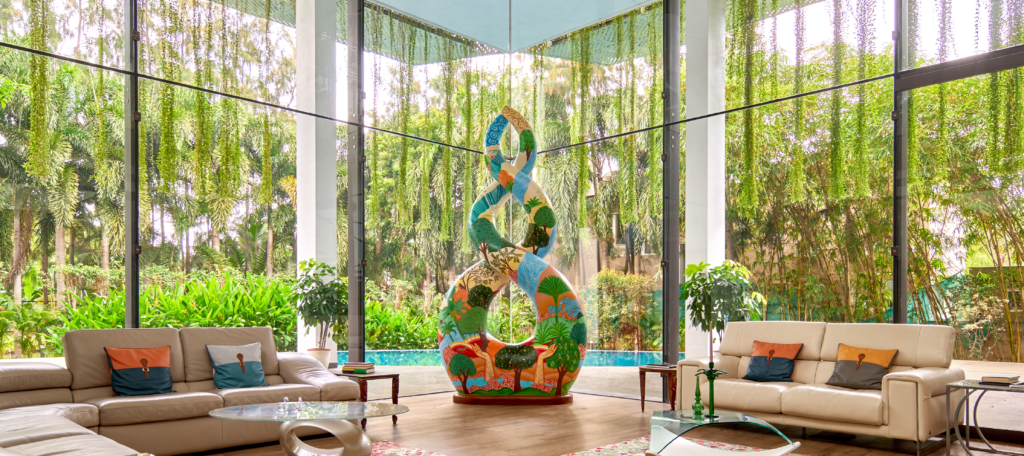
Think about the last space that stayed with you. A restaurant, a hotel lobby, someone’s living room. What do you actually remember about it?
Not the sofa. Not the rug. Probably one thing. One object that the whole room seemed to be built around.
That’s a statement piece. And most spaces don’t have one.
It’s not about size or price
A statement piece isn’t the most expensive thing in the room. And it doesn’t have to be huge.
It’s the object that holds the room together. Take it out and the space loses its point of view. It becomes a collection of things rather than a space with something to say.
That could be a dhokra lamp with a form you can’t stop looking at. A hand-carved jaali screen that turns flat afternoon light into something interesting. A brass console that just sits there in a corner and makes everything around it look more considered.
What these objects have in common isn’t the material or the cost. It’s that they were made with intention. And that comes through.
Here’s the thing about Indian craft
We work with Indian craft traditions every day, and honestly, there’s nothing quite like them anywhere in the world.
Bidriware from Bidar. Dhokra from Bastar. Stone work from Jaipur. Brass from Moradabad. Each one is a completely different visual language with centuries of knowledge behind it.
But most Indian interiors still ignore all of this and go straight to a catalogue.
You end up with spaces that could be anywhere. Offices in Mumbai that look like Singapore. Homes that could be in any city on earth. When you’re sitting on this much craft heritage, that feels like a real waste.
What a room looks like without one
You’ve been in these spaces. Everything checks out. The furniture is good, the lighting is considered, the palette works. But you walk out and forget the whole thing within ten minutes.
Here’s why: nothing took responsibility for the room. Nothing gave it a point of view.
There’s a design principle worth knowing, when everything is trying to be a statement, nothing is. One strong object, given room to breathe, does more than twelve things competing for attention.
How to actually find yours
Don’t start by looking at what’s missing in the room. Start by asking what the room should feel like.
Grounded and culturally rooted? Look at a hand-woven textile, a craft object in natural materials. Bold and confident? A large-format mural or a forged metal piece. Warm and layered? Something in natural dyes that gets better over time, not worse.
The right object follows the feeling. Not the other way around.
And when you find it, you’ll know. It’s the handcraft piece you keep going back to. The one you want to tell people about.
Start there. The rest of the room is easier after that.
Baaya Design creates custom statement pieces, murals, art furniture, craft installations, for homes and commercial spaces. See our work or talk to us about your space.