

Most people have had this experience at least once.
You walk into a space, a home, a hotel room, sometimes even an office, and something just settles. You feel calmer. More comfortable. Like you could stay a while without trying.
And then you walk into a different space that looks, on paper, just as good. Same light, similar furniture, comparable budget. But it feels wrong somehow. Slick but cold. Put together but empty.
The gap between those two experiences isn’t luck. It’s design. Specifically, it’s whether whoever designed the space was thinking about how it would feel, or just how it would look.
Looks Good in Photos ≠ Feels Good in Person
This split happens a lot in Indian design right now. Spaces built entirely for the Instagram grid. Everything is calibrated for a wide-angle lens, the right palette, the right composition, the right “wow” moment on camera.
And then you sit in the room and feel nothing.
Because a space isn’t a photograph. It’s a physical experience. And when designers stop thinking about how a space feels to be inside, you end up with rooms that impress briefly and then leave you flat.
The spaces people actually love, that they return to, recommend, reference for years, are the ones where someone was designing for the person standing in the room. Not the person scrolling past it.
Why Material Actually Matters
There’s a simple test. Put a hand-thrown clay pot and a factory-made ceramic on the same table. Same shape, similar glaze. Most people will reach for the hand-thrown one.
Not because they’ve been told it’s better. Because it reads differently. The slight variation in the wall thickness. The small imperfections in the surface. The evidence that a human being made this, by hand, with skill.
Objects like that change the feel of a room. And India has an extraordinary supply of them –
- Dhokra from Bastar
- Hand-knotted textiles from Kashmir
- Stone work from Rajasthan
- Bidriware from Karnataka
These aren’t just beautiful objects. They carry the knowledge of the person who made them. That comes through in a space, even when you can’t explain exactly why.
A room full of handmade craft objects feels different from a room full of factory furniture. Not more “traditional.” Just more real. And real is what people connect with.
The Thing Most Designers Get Backwards
Ask a designer what the brief is and they’ll usually show you a mood board. A visual direction. What the space should look like.
But the more important question is what the space should feel like.
- Calm and easy?
- Energised and focused?
- Warm and rooted?
- Quietly impressive?
Those are feeling words, not visual ones. And once you know the feeling, the visual decisions follow naturally. The materials, the light, the objects, the art, all of it becomes clearer when you know what emotional experience you’re trying to create.
This is actually how we work at Baaya. We start with the feeling question, not the mood board. It changes everything about what gets chosen, and why.
What People Actually Remember
Ask someone to describe a space they loved and they almost never describe the whole room.
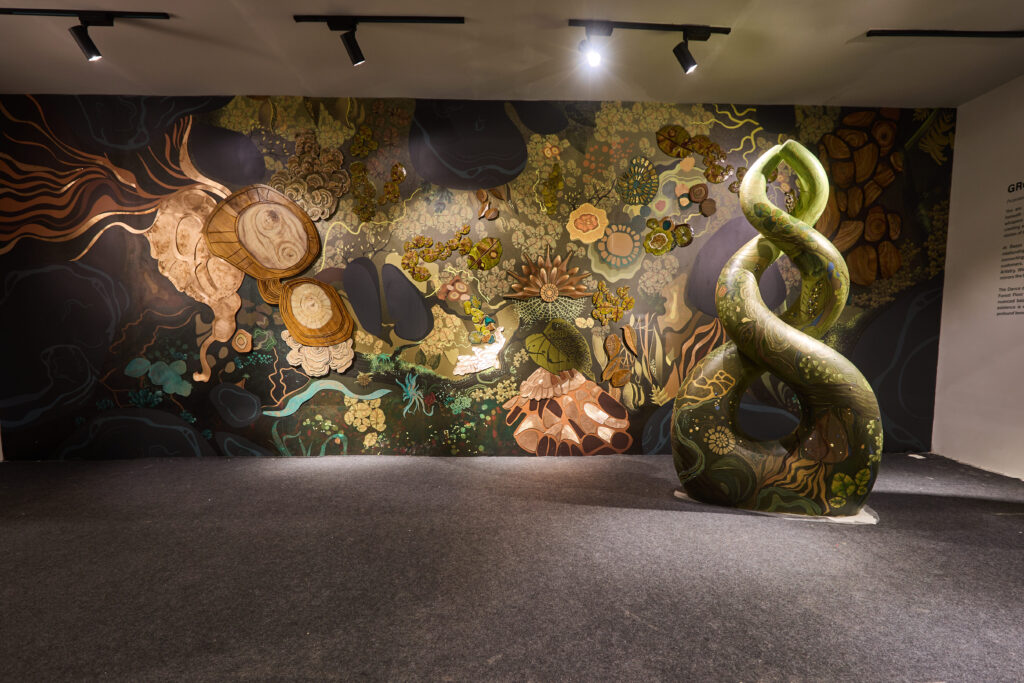
They describe a detail. The way light came through a carved screen and made patterns on the floor. The texture of a rough stone wall their hand brushed in a corridor. A hand-painted mural they stood in front of for five minutes without meaning to. The particular quality of quiet in a room with thick cotton curtains and a kota stone floor.
Those details aren’t accidents. They’re the result of someone deciding that this space deserves more than the obvious choice. A handcrafted art piece instead of a stock print. A considered object instead of whatever fits. Real materials instead of imitations.
Small decisions, made deliberately, are what people carry with them. Not the overall look. The specific thing that stopped them.
One More Honest Thing
Emotional connection in a space doesn’t happen because a designer was clever. It happens because someone slowed down enough to ask the right questions before picking anything.
- What does this person need to feel here?
- What would make them want to come back?
- What would make this space genuinely theirs, not just good-looking?
Those are simple questions. But they’re the ones that separate spaces people forget from spaces people remember.
Baaya Design works on spaces that people actually connect with, homes, offices, hotels, airports. See what we’ve done or get in touch.