

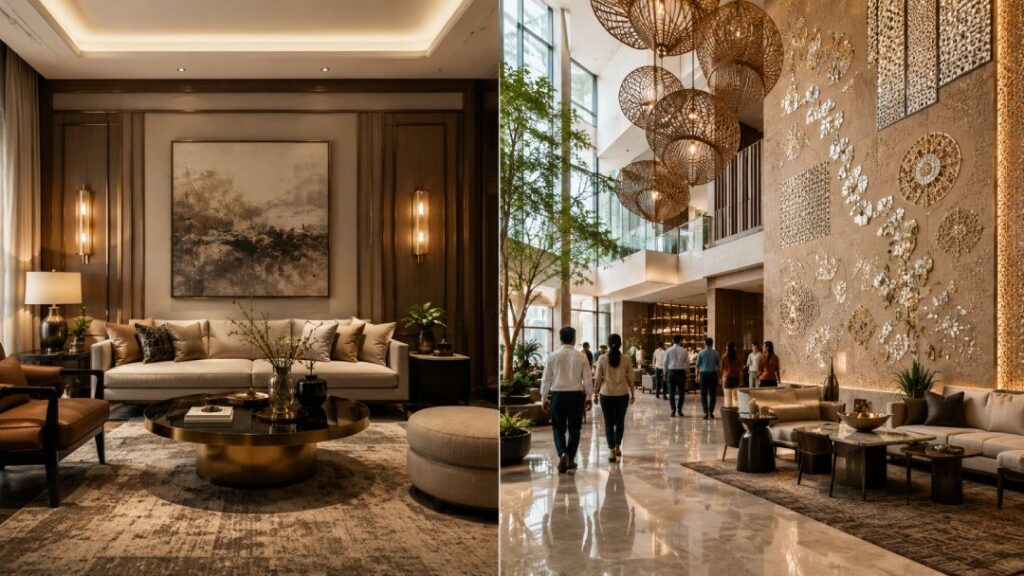
Let’s get straight to it: you can have a beautifully decorated room that feels terrible to sit in.
Maybe the acoustics amplify every footstep. Maybe the lighting makes you feel like you’re under interrogation by 3 PM. Or maybe the room just feels ‘off,’ even though the furniture cost a fortune. This disconnect is the exact friction point where interior design ends and spatial design begins.
If you are a developer, an architect, or a corporate founder planning your next major project, understanding the difference between the two isn’t just semantics, it dictates the entire functional success of your environment.
Interior Design is About the Finish. Spatial Design is About the Flow.
Interior design generally steps in when the structural bones of a space are already finalized. It asks: What color should these walls be? What fabric works on this lounge chair? Does this rug tie the room together? It is an essential discipline, but its primary concern is visual cohesion and aesthetics.
Spatial design is far more invasive. We look at the bare, skeletal volume of an environment and ask behavioral questions:
• How will a person naturally want to move from the reception desk to the meeting rooms?
• Can we manipulate the natural light to draw people toward a specific collaboration zone?
• How does the volume of this ceiling impact cognitive load and stress levels?
Spatial design studio sits at the exact intersection of interior architecture, environmental psychology, and art integration.
The Baaya Difference: Art as Architecture
Where most interior designers will source a piece of wall art to complement a sofa, a spatial designer builds the art into the architecture itself.
At Baaya Design, we don’t buy craft artifacts to fill empty shelves. We work with over 15 indigenous art forms, from complex Lippan mud work to intricate Thikri glass inlay, and scale them up to become integral spatial elements.
Imagine an expansive corporate atrium. An interior designer might specify an imported chandelier. As spatial design consultants, we might conceptualize a massive, two-story lighting installation crafted entirely from traditional Dokra metal casting, designed to scatter light perfectly while telling the cultural story of the region.
When Do You Need Which?
• Hire an Interior Designer when: You have an existing space that works well functionally, but needs a visual refresh, new furniture, or a cohesive aesthetic identity.
• Hire a Spatial Design Studio when: You are conceptualizing a new boutique hotel, a corporate headquarters, or an expansive residential property. You need the space to dictate human behavior, manage foot traffic, and communicate a deep, localized narrative from the moment someone walks in.
The Bottom Line
Spaces shouldn’t just be decorated; they need to be engineered for human experience.
Are you planning a project that requires more than just a surface-level design? We specialize in craft-led spatial design for hospitality, commercial, and luxury residential projects across India. Consult with Baaya’s Spatial Design Team Today.