

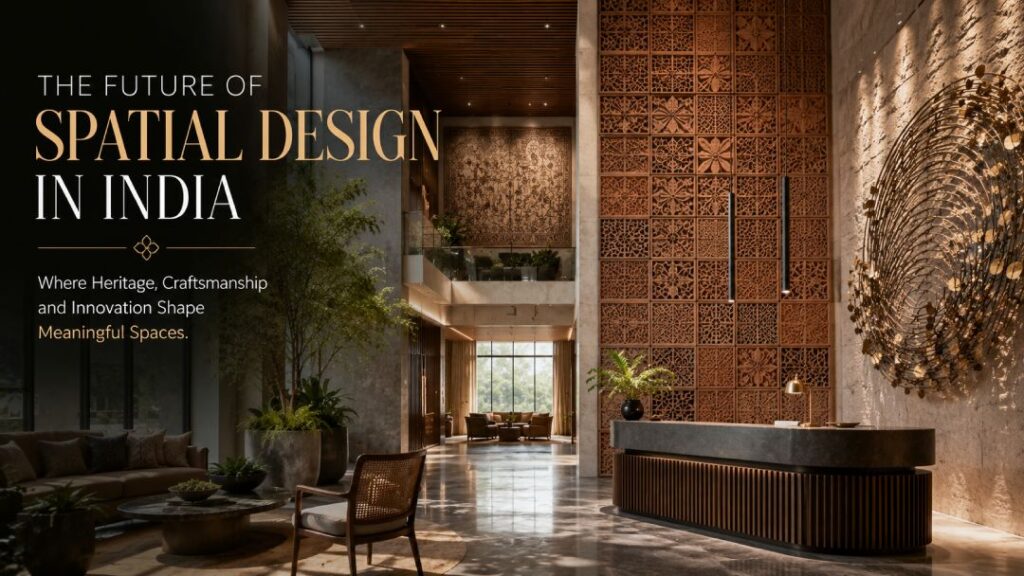
For the last two decades, if you walked into a luxury corporate office in Mumbai or a high-end resort in Bengaluru, you were likely looking at a replica of the West. Sleek glass facades, imported Italian marble, and minimalist, sterile lobbies were the universal shorthand for ‘premium.’
But the landscape is shifting rapidly. The most celebrated architects and spatial designer studio in India today are realizing something crucial: spaces stripped of their cultural context lack a soul.
The future of spatial design in India isn’t about looking outward anymore. It’s about looking inward. It is the era of Indigenous Luxury.
The End of the “Copy-Paste” Corporate Aesthetic
Post-pandemic, the way we consume spaces has changed. Whether it’s an employee returning to a workspace or a traveler checking into a resort, people are seeking authenticity. They want a sense of placemaking, they want to know exactly where they are in the world.
If your corporate headquarters in Hyderabad looks identical to an office in Frankfurt, you are missing a massive opportunity for brand storytelling.
This is where the integration of Indian master crafts comes into play, not as afterthoughts, but as foundational architectural elements.
Scaling Heritage: From the Village to the Atrium
India holds a staggering repository of traditional craftsmanship, but for too long, it was relegated to tabletop souvenirs or ethnic niches. The future of Indian spatial design lies in taking these centuries-old techniques and scaling them for the contemporary world.
At Baaya Design, we pioneered this transition. We have seen firsthand what happens when you take a technique like Copper Enamel and blow it up into a massive, 40-foot feature wall for a commercial lobby. Or when you take traditional Pichwai painting and reinterpret its motifs into subtle, modern metal screens that divide a high-traffic restaurant.
When we worked on iconic spaces like the Tata Bombay House, the goal wasn’t just to make it look ‘Indian.’ The goal was to use indigenous materials to solve modern spatial problems acoustics, light filtration, and wayfinding.
Sustainability as a Byproduct of Heritage
You cannot talk about the future of design without talking about sustainability. But true sustainability isn’t just about using recycled plastics; it’s about reducing the carbon footprint of logistics.
Why import stone from Europe when local laterite, Kotah, or custom terracotta can be manipulated to look incredibly avant-garde? By integrating local artisan clusters into the commercial fabrication process, modern spatial design reduces environmental impact while actively preserving local micro-economies.
The Takeaway
The future of Indian design is fiercely local, unapologetically authentic, and brilliantly modern. We are no longer borrowing design languages; we are creating our own.
Want to embed authentic Indian storytelling into your next architectural project? Baaya Design collaborates directly with principal architects and developers to seamlessly integrate bespoke, craft-led spatial solutions. Book a Strategy Call today.