

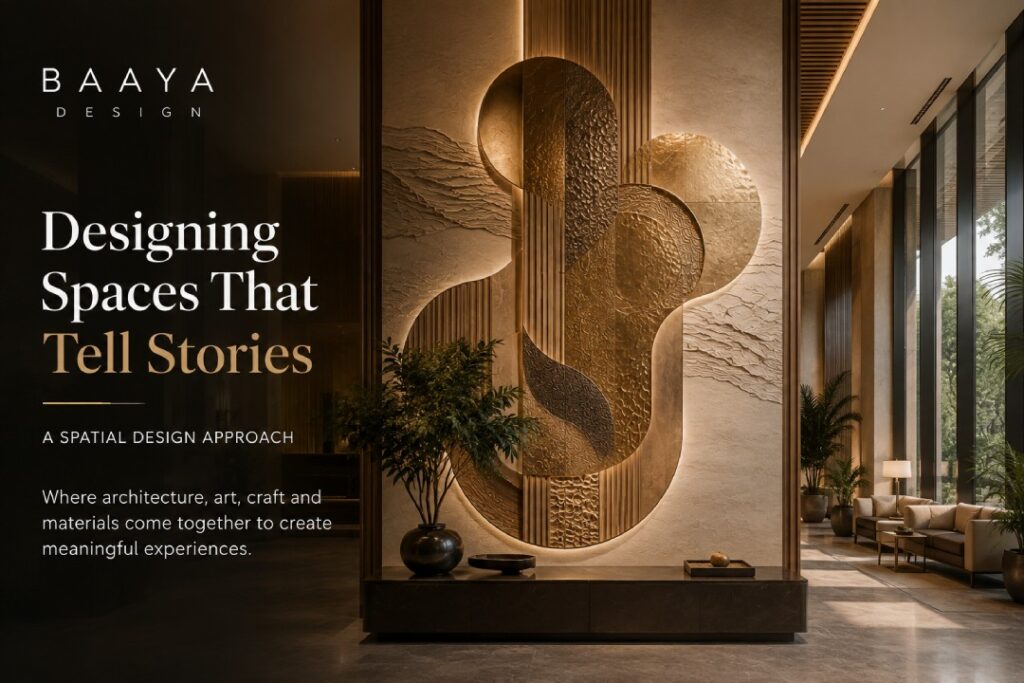
Every space communicates something, whether deliberately or unintentionally. A hotel can reveal something about the landscape around it, a workplace can communicate how an organisation sees itself, and a residence can hold references to family, memory and personal history.
Spatial storytelling is the process of translating these ideas into a physical experience. It is not simply about adding a mural that illustrates a story or placing explanatory text throughout an interior. Instead, it asks how architecture, materials, art, objects, craft and movement can work together so that the space itself becomes the medium through which a story is experienced.
When storytelling is approached this way, it becomes less about decoration and more about giving design decisions a clear reason to exist.
What does storytelling through spatial design mean?
Spatial storytelling translates an idea into a sequence of physical experiences. Architecture establishes the structure, materials create atmosphere, objects introduce detail, art creates moments of emphasis and circulation determines the order in which these elements are discovered.
A hospitality space inspired by its surrounding landscape, for example, does not need to represent that landscape literally. Instead, colours may shift gradually through the property, surfaces might reinterpret geological textures, or an artwork could respond to wind, vegetation or water in an abstract way.
The reference remains recognisable at the level of concept rather than through obvious imagery.
This is often what makes spatial storytelling feel more sophisticated. The visitor can enjoy the environment without needing to decode every reference, while someone who understands the context can discover additional layers of meaning.
Begin with the story, not the motif
One of the easiest ways for culturally inspired design to become superficial is to begin with motifs rather than ideas.
A designer researches a location, identifies familiar patterns or symbols and applies them to walls, fabrics or decorative features. The result may communicate a geographical association, but it does not always express anything meaningful about the place itself.
A stronger process begins by identifying what is genuinely interesting about the context.
Perhaps the story is connected to migration, trade, landscape, a particular craft tradition, local industry, a river system, a botanical species or an aspect of cultural memory. Each of these subjects contains far more possibilities than a decorative pattern alone.
Once the underlying story has been identified, designers can choose how directly it should appear. Some elements may be recognisable, while others can be highly abstract.
The important thing is that each design decision remains connected to the central idea.
Spatial sequencing gives the story structure
Stories do not usually reveal everything at once. They have beginnings, transitions, moments of emphasis and quieter passages. Spaces can function in a similar way.
An entrance establishes the first impression. A corridor can introduce another layer of the narrative. A lobby may become the primary moment of expression. Smaller interventions in guest rooms, meeting spaces or transitional areas can provide more intimate discoveries.
Thinking this way prevents storytelling from becoming concentrated in a single feature wall.
Instead, the idea can unfold gradually throughout the property.
This approach is especially valuable in bespoke hospitality design because guests experience hotels over time. They may walk through the same lobby repeatedly, notice artwork from different angles, encounter another reference in a restaurant and discover a smaller craft detail inside their room.
A narrative that develops across these encounters can create greater depth than one oversized statement alone.
Art can become part of the architecture
Site-specific art is particularly effective in spatial storytelling because it can respond to both narrative and architecture.
A work can be scaled to a particular wall or void. Its composition can follow circulation. Its materials can connect to surrounding finishes. It can be positioned specifically in relation to daylight or designed around the distance from which people will first encounter it.
This is very different from purchasing an artwork and later deciding where it should hang.
When art is designed for a space, the architecture becomes one of its inputs.
A long wall might inspire a flowing or sequential composition. A tall atrium might suggest suspension or vertical movement. A curved surface could influence the geometry of the work.
The resulting intervention does not simply communicate a story visually. It becomes part of how the building itself is experienced.
Craft carries cultural and material knowledge
Craft can add another layer to spatial storytelling because a traditional technique contains knowledge accumulated through generations of making.
The value of craft does not lie only in its familiar motifs. It also exists in the behaviour of the material and the process used to shape it.
Metal may be beaten, folded, enamelled or etched. Embroidery creates rhythm through stitch. Inlay depends on precision and contrast. Mirror work changes through reflection. Hand-painted surfaces carry the gesture of the maker.
Understanding these characteristics gives designers greater freedom to reinterpret a craft tradition without simply reproducing historical forms.
A traditional technique can be used within an abstract contemporary composition. A process associated with smaller decorative objects can be translated to architectural scale. A familiar material might be combined with another medium to produce an entirely different effect.
In this way, craft becomes an active design resource rather than a nostalgic reference.
Storytelling should not overwhelm the space
There is a danger in trying to make every element symbolic.
When every colour, object and material is accompanied by an elaborate explanation, the space can begin to feel instructional. The story should deepen the experience rather than control it.
A visitor should still be able to appreciate a crafted surface without knowing exactly what inspired it. A hotel guest should be able to enjoy an artwork for its composition, texture and material even if they do not immediately recognise the cultural reference.
The narrative becomes an additional layer rather than a requirement.
This balance is particularly important in luxury and contemporary environments, where subtlety often creates a stronger impression than literal storytelling.
Materials can carry narrative without imagery
Material choices themselves can communicate meaning.
Local stone connects directly to geography. Reclaimed timber carries traces of time. Metal may reference industry or craftsmanship. Handmade ceramic reveals variation between individual pieces. Patinated surfaces suggest age and transformation.
Because materials already carry associations, they can communicate aspects of a story without depicting anything.
This becomes particularly interesting when traditional processes meet contemporary forms. A historic technique executed at architectural scale can be experienced completely differently from the same technique used on a small object.
Scale changes interpretation. Context changes interpretation. Light changes interpretation.
These shifts create opportunities for new design languages that feel rooted in craft while remaining relevant to contemporary architecture.
What architects and developers can do differently
The most important practical shift is to introduce conversations about story earlier in the project.
If identity and art are discussed only after major architectural decisions have been completed, opportunities may already have been lost. A potential installation wall may have been broken by services. A double-height space may not have suitable fixing points. Lighting may not support a material intervention.
Early collaboration creates more possibilities.
A staircase void can become a location for a suspended work. A long circulation route may support a narrative installation. A ceiling can become an unexpected surface. A threshold between two zones can be emphasised through material change.
When the architectural and artistic thinking develop together, the boundary between architecture, interiors and art becomes more fluid.
This is often where the most distinctive spaces emerge.
Questions that can uncover a spatial story
Before beginning the design narrative, teams can ask:
- What belongs uniquely to this place?
- What is genuinely worth preserving, interpreting or communicating?
- What should a visitor understand immediately?
- What should reveal itself gradually?
- Which materials naturally support the story?
- Where does the architecture already create an opportunity for expression?
These questions help distinguish a meaningful narrative from a decorative theme.
A story gives design a reason
The purpose of spatial storytelling is not to make every environment conceptually complex. It is to create coherence.
Why this material? Why this artwork? Why this form? Why this location?
When those answers connect back to the place, brand, culture or people behind a project, individual design decisions begin to belong to a larger whole.
A story is therefore not something applied to a finished interior. At its best, it is one of the ideas that guides the design from the beginning.
This is how spaces become specific. Not because they contain more information, but because the architecture, material and art share a common reason for being there.
Baaya Design collaborates with architects, interior designers, developers and brands to translate stories into bespoke art, craft-led surfaces and spatial interventions created specifically for their architectural context.