

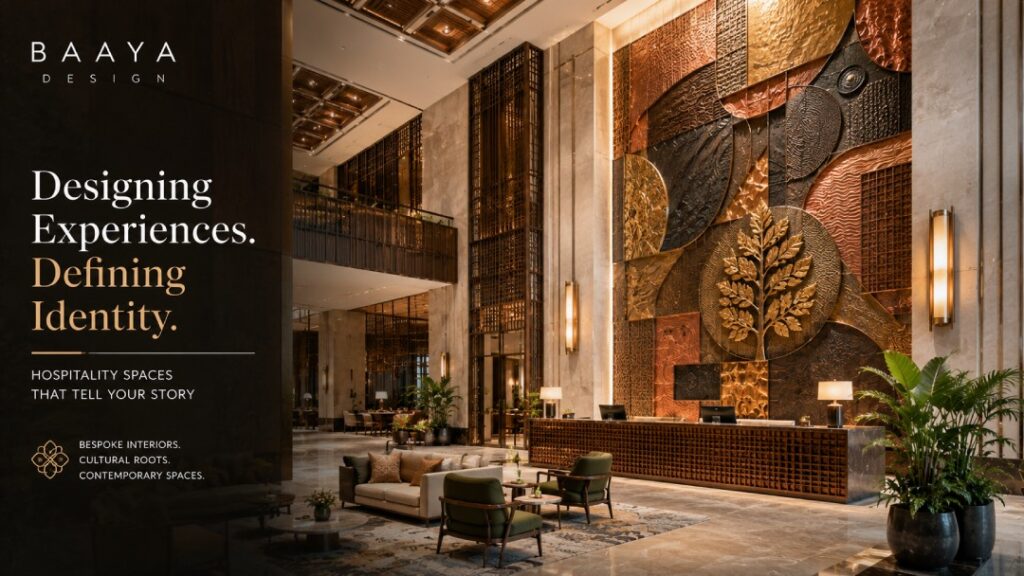
A guest may forget the dimensions of a hotel lobby, the exact colour of a wall or even the furniture they sat on. What often remains is something less tangible: how the place felt. Perhaps it was the transition from a quiet entrance into an expansive courtyard, a crafted surface that revealed something about the region, or an artwork that could only have belonged to that property. These details become part of how a guest remembers a place.
This is where design identity becomes important in hospitality. A strong hospitality identity is not simply a colour palette, a decorative style or a collection of recognisable brand elements. It is created through the relationship between architecture, material, art, craft, culture and experience. When those elements are considered together, a hotel or restaurant begins to develop a character that feels specific to its location and its brand rather than interchangeable with another well-designed property.
Craft Can Be Contemporary Without Losing Its Roots
Bespoke hospitality design identity is the distinctive spatial language through which a hotel, resort, restaurant or hospitality brand expresses who it is. It can emerge through architecture and planning, but also through lighting, furniture, artwork, materials, objects, landscape and the sequence in which guests encounter these elements.
The most convincing identities usually begin with questions rather than aesthetics.
- Where is the property located?
- What is particular about its cultural or geographical context?
- Who is it designed for?
- What does the brand want people to feel?
- Which aspects of the site deserve to be noticed or remembered?
These questions create a foundation from which design decisions can grow. A coastal property, for example, does not need to rely on obvious references such as shells, waves or shades of blue. Its relationship with the coast might instead be expressed through reflective surfaces, filtered light, weathered textures, fluid forms or artworks inspired by tidal movement. The location remains present, but it is interpreted rather than illustrated.
This distinction is valuable because identity becomes more meaningful when it comes from the underlying character of a place rather than from surface-level motifs.
Why identity matters to hospitality brands
Hospitality is experienced as a sequence. Guests arrive, move through thresholds, check in, travel through corridors, enter guest rooms, spend time in restaurants or lounges and encounter the property repeatedly over the course of their stay. Every stage contributes to how the brand is perceived.
A coherent design identity helps these different experiences feel connected without making every room look the same. Consistency does not have to mean repetition. A lobby installation, a restaurant wall and a detail within a guest room may all look different while still sharing the same material logic, cultural reference or design philosophy.
For hospitality brands operating across multiple properties, this is particularly important. A rigid visual formula can make hotels in completely different places feel increasingly similar. A stronger approach is often to establish principles rather than fixed decorative rules. A brand may consistently value local craftsmanship, material richness or site-specific storytelling while allowing each property to interpret these principles through its own context.
That creates recognition without sacrificing individuality.
Sense of place should be built into the design
Many bespoke hospitality projects introduce local culture or identity through artwork only after the architecture and interiors have largely been resolved. This can create attractive decoration, but it is more difficult to create a genuine sense of place when art is treated as a final layer.
Site-specific art is more powerful when it is considered alongside the architecture. A long circulation wall might become an opportunity for a narrative artwork. A double-height entrance may suggest a suspended installation. A transition from interior to landscape may inspire a material intervention that responds to changing daylight.
The architecture begins to influence the artwork, while the artwork contributes to how the architecture is experienced.
At Baaya Design, this relationship is central to how we think about spatial art. The question is not only what artwork should occupy a wall, but why an intervention belongs in that particular location. Scale, surrounding material, lighting, sightlines and the way people move through the space all influence the design.
When these factors are considered from the beginning, art starts to feel embedded rather than added.
Craft can be contemporary without losing its roots
Craft can play an important role in creating identity, particularly in hospitality spaces that want to establish a relationship with culture and place. However, using craft effectively requires more than reproducing traditional motifs.
A craft tradition contains knowledge about material, process and making. The distinctive quality may lie in the way metal is beaten, glass is arranged, embroidery builds texture, wood is inlaid or clay is shaped by hand. These qualities offer opportunities for contemporary reinterpretation.
Instead of reproducing a familiar pattern exactly, designers can study what makes the technique unique and explore how those characteristics might operate within a different scale, geometry or spatial context. A traditionally small object may inspire an architectural surface. A historic process may be used to create an abstract installation. A material associated with decorative craft might become a contemporary focal point within a restrained interior.
The objective is not to disguise the origins of the craft. It is to allow its material intelligence to participate in present-day design.
This approach also avoids reducing culture to visual symbolism. When craftsmanship is incorporated through process and material rather than through obvious motifs alone, the result can feel both culturally grounded and architecturally relevant.
Materials shape how a place is remembered
Materiality is another important component of hospitality identity because materials communicate before people consciously analyse them. A polished stone surface creates a different atmosphere from hand-finished timber. Brass develops character as it ages. Textiles affect both tactility and acoustics. Reflective materials respond constantly to movement and light.
These qualities influence how a space feels throughout the day.
For this reason, material selection should move beyond assembling an attractive palette. Designers can consider how a material behaves under natural light, whether people will touch it, how it will age and what kind of visual detail it reveals at different distances.
Some of the strongest material experiences are those that change with time or viewpoint. A textured metallic surface may appear quiet from a distance but become highly detailed when approached. A handcrafted finish may reveal subtle irregularities that remind the viewer that a human hand was involved in its making.
These details contribute to a sense of authenticity and can become part of the property’s visual memory.
Designing the element guests remember
A useful question for any hospitality project is: what will become the visual memory of this place?
The answer does not always need to be the largest element in the room. It could be a staircase, a sculptural light, a crafted reception backdrop, an unusual threshold or a work of art discovered unexpectedly.
What makes such moments memorable is often their specificity. A bespoke intervention created for one location already possesses something a catalogue object cannot. Its dimensions, materials and narrative can respond to the particular architecture and story of the property.
This is especially relevant as hospitality interiors become increasingly accessible through global reference imagery. It is now relatively easy for multiple properties to share similar finishes, furniture silhouettes or aesthetic trends. Site-specific design creates an opportunity to move away from visual familiarity and towards a more distinctive experience.
Questions hospitality teams should ask early
Hotel owners, developers, architects and interior designers can strengthen a project’s identity by addressing a few questions early in the design process:
- What is genuinely particular about this location?
- What should a guest feel within the first few minutes of arrival?
- Which story belongs specifically to this property or brand?
- Where are the natural opportunities for pause, discovery or surprise?
- Which materials could become distinctive signatures of the space?
- What might guests remember after they leave?
These questions change the conversation from simply asking how a hotel should look to considering what it should communicate and how it should be experienced.
A strong identity should be difficult to reproduce elsewhere
The most memorable hospitality spaces rarely need to announce their individuality loudly. Identity may be expressed through the rhythm of a screen, the detail of a locally developed material, a crafted surface or an artwork positioned precisely in relation to the architecture.
Together, these decisions create an environment that feels coherent and specific. The strongest hospitality spaces often give the impression that their architecture, material, art and story could not have come together in quite the same way anywhere else.
That is the real value of design identity. It is not differentiation for its own sake. It is the creation of a deeper relationship between brand, place and experience.
Planning a hospitality space? Baaya Design works with architects, developers and hospitality brands to develop bespoke art and spatial interventions rooted in story, material and craft.