

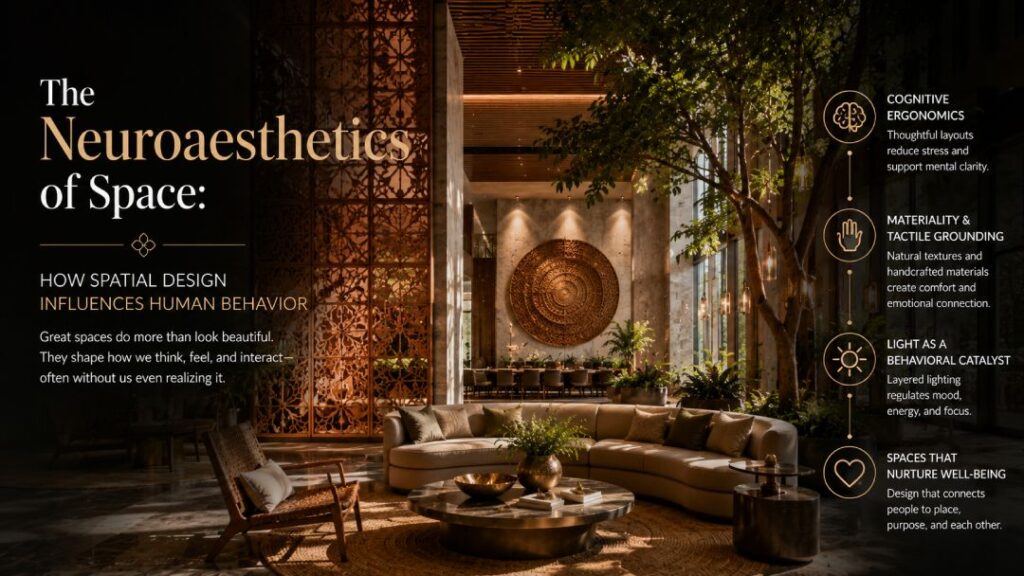
We have all walked into a room and instantly felt our shoulders drop, or conversely, felt an inexplicable spike in anxiety. While we often chalk this up to a room’s ‘vibe,’ the reality is rooted in a highly measurable science: neuroaesthetics.
Spatial design is not merely about filling a room with beautiful objects; it is the invisible architecture of human behavior. At its highest level, spatial design manipulates proportion, light, and materiality to dictate how we move, interact, and feel within an environment.
Cognitive Ergonomics: Designing for the Subconscious
Standard interior design focuses on visual cohesion. Spatial design, however, focuses on cognitive ergonomics, how an environment supports mental processing. A cramped layout or disjointed spatial flow forces the brain to constantly process navigational micro-stressors.
By prioritizing intuitive pathways and purposeful zoning, effective spatial design reduces cognitive load. This is why a well-designed open-plan commercial area naturally draws people together, while a poorly laid-out one leaves pockets of dead, unused space.
Materiality and Tactile Grounding
Humans are biologically hardwired to respond to natural textures a concept known as biophilia. Sterile, mass-produced environments often trigger subconscious fatigue. This is where the integration of authentic, handcrafted materials becomes a behavioral tool.
Integrating tactile elements, such as a hand-beaten copper mural or a custom terracotta jaali screen, provides sensory grounding. These elements offer a profound psychological anchor, reducing stress and fostering a sense of permanence and peace.
Light as a Behavioral Catalyst
Lighting does more than illuminate; it regulates our circadian rhythms. Dynamic spatial design utilizes layered lighting—blending abundant natural light with strategically placed ambient and accent lighting. A custom lighting installation doesn’t just brighten a room; it signals to the brain that it is time to transition from high-focus work mode to social connection.
The Baaya Approach: Spaces that Speak
We don’t just decorate spaces; we engineer environments that elevate human potential. By blending cutting-edge spatial psychology with India’s rich heritage of master craftsmanship, we create environments that foster deep emotional resonance.
Is your bespoke hospitality space or workplace supporting well-being? Connect with Baaya’s expert spatial design studio to explore how we can elevate your environment. [Insert Link to Consultation]