

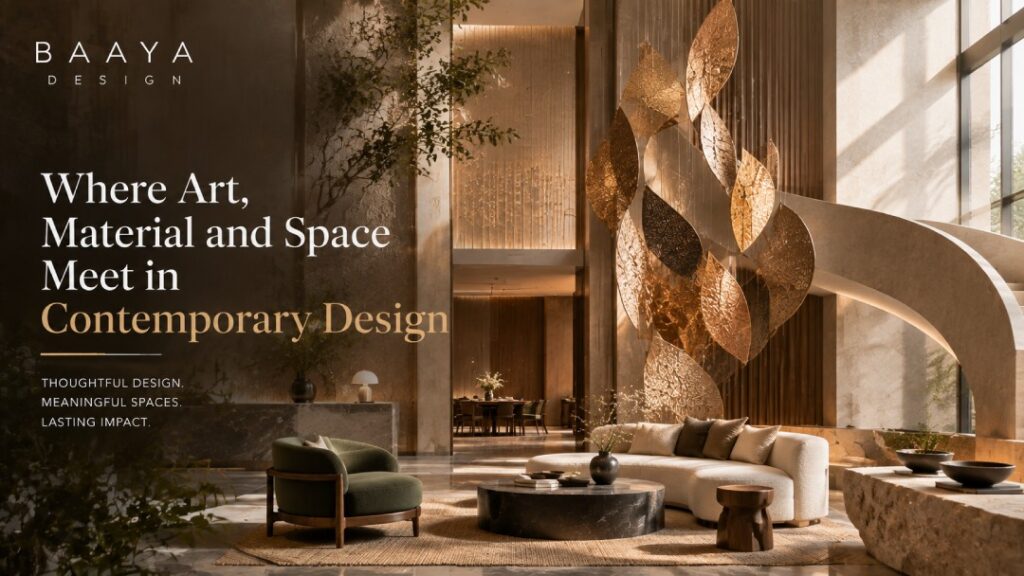
A large wall does not automatically require a large artwork, just as a double-height lobby does not necessarily need a dramatic sculpture. Even a beautifully crafted object can feel disconnected when it has not been considered in relation to the architecture around it.
The relationship between art, material and space is more complex than matching colours or finding an object that fits an available surface. Architecture determines scale and viewpoint. Material influences texture, light and character. Movement changes how the work is encountered.
When these elements are considered together, art can become part of the spatial experience rather than something added to a completed interior.
The most successful interventions often feel as though they could not have been designed independently of the space they occupy.
Art changes when it becomes spatial
An artwork viewed on a table or in a studio is experienced differently from the same work placed inside a hotel lobby, residence or workplace.
Architecture introduces distance, human scale, circulation, furniture, daylight and surrounding materials. These relationships change the way the artwork is read.
A piece that feels substantial in isolation may almost disappear against a nine-metre wall. A highly detailed surface that photographs beautifully at close range may lose its impact when viewed across a lobby. A sculptural object may appear very different depending on whether it is approached from the front, seen from above or encountered while walking past.
For this reason, site-specific art should begin with an understanding of how people will experience the location.
Where will they first see the work? How close can they get? Will they approach it directly or pass alongside it? Can it be viewed from more than one level? How does daylight move through the area?
The answers can fundamentally change the design.
Material is not simply something applied at the end
Material is often discussed as a finish, but in many strong spatial interventions it is much more than that.
Every material has a behaviour.
Metal can bend, reflect, oxidise and develop patina. Glass can transmit, distort and reflect light. Textile introduces softness, depth and sound absorption. Clay retains subtle traces of the hand. Stone carries weight and geological character. Wood introduces grain, warmth and natural variation.
These qualities can become starting points for design.
Instead of creating a form first and later deciding how to manufacture it, designers can ask what a particular material naturally allows them to explore.
Sheet metal may lead towards folding or layering. Wire can create linear structures. Enamel brings colour into metal while retaining a crafted quality. Embroidery can create density through repetition. Mirror can fragment views of the surrounding architecture.
When the properties of the material participate in generating the concept, the result tends to feel more authentic than when the material is selected only for appearance.
Scale can transform the way craft is experienced
Craft traditions are often encountered through smaller objects because this is the scale at which many techniques historically developed.
Spatial design creates an opportunity to reconsider that scale.
A handcrafted detail originally measured in centimetres might be reinterpreted across an entire wall. A technique usually associated with decorative objects may become part of an architectural surface. The geometry of a small crafted artefact might inspire a much larger sculptural installation.
However, working at architectural scale requires more than simply enlarging a pattern.
- The technique itself needs to be reconsidered.
- Will the structure support the new dimensions?
- How will the piece be transported?
- Which details remain visible from the intended viewing distance?
- Can the process still be executed effectively? How will individual modules connect?
These practical questions influence the design and can create new visual possibilities.
For Baaya design, this intersection between craft and architectural scale is particularly important. Craft does not have to remain confined to the object. Its techniques, textures and material intelligence can become part of the space itself.
Contemporary design does not have to eliminate the handmade
Contemporary interiors are often associated with controlled geometry, clean lines and precisely manufactured finishes. Craft can appear, at first, to sit in contrast with this language.
In practice, the relationship can be highly complementary.
A handcrafted element introduces variation into an environment where much of the surrounding architecture may be extremely controlled. Hammer marks, stitching, subtle irregularity, patina and texture create visual evidence of making.
This does not mean contemporary spaces need traditional decorative motifs.
A historic craft technique can be used to create an abstract composition. Embroidery can become a large textural landscape. Metalwork can form a minimal sculptural installation. Mirror or glass techniques can be used to manipulate light rather than produce conventional ornamentation.
The process remains rooted in craftsmanship, but the visual language belongs to the present.
This is one of the ways craft can remain relevant rather than being treated as something preserved only through repetition.
Art should respond to movement
One of the fundamental differences between spatial art and conventional wall-based artwork is that viewers rarely experience it from a single fixed position.
People move around it.
A sculpture may initially appear as a silhouette from the entrance. As someone walks closer, layers become visible. From another angle, openings appear between elements. Reflections change constantly.
The artwork becomes temporal because it changes in relation to movement.
Wall-based work can behave in similar ways. Relief can produce shifting shadows. Metallic elements can respond to changing light. A composition may become denser or quieter depending on the angle from which it is viewed.
This can make the viewer an active participant in the experience.
Instead of consuming the work as a single image, they discover it gradually through space.
The architecture should influence the gesture
A successful art intervention often begins with something already present in the architecture.
A tall void suggests verticality. A curved wall may encourage flow. A long corridor introduces rhythm and repetition. A strong structural grid might provide a framework that the artwork either follows or deliberately interrupts.
Responding to architecture does not mean the artwork has to disappear into it.
Contrast can be equally effective.
A soft embroidered work against stone can emphasise tactility. A dark sculpture within a pale interior can create a visual anchor. A reflective installation inside a matte environment can animate movement and light.
What matters is that the relationship feels intentional.
Art and architecture do not need to match. They need to communicate with one another.
Prototyping is part of the design process
Bespoke work inevitably contains questions that cannot be fully resolved through drawings or renders.
How reflective will a metal actually be under site lighting? Will the depth of a texture remain visible from across the room? How will a patina respond to the fabrication process? What will the finished work weigh? How can it be mounted without compromising the architecture?
Mock-ups and prototypes allow these questions to be explored before final production.
They also create opportunities for discovery.
A finish that seemed subtle in a drawing may become surprisingly powerful when produced at scale. A particular fold may catch light in an unexpected way. A surface initially selected for its colour may become more interesting because of its texture.
This is why experimentation should not be seen merely as technical validation. It is often a creative part of the design process itself.
Site-specific art creates differentiation
Commercial and hospitality interiors can easily become collections of globally available products. Furniture, lighting and finishes may all be beautifully designed while still producing a space that feels strangely familiar.
Site-specific art offers an opportunity to introduce something that cannot simply be ordered again for another project.
Its dimensions can belong to a particular wall. Its material can respond to the surrounding palette. Its narrative can connect with a location or brand. Its fabrication may involve a particular craft technique or process.
This specificity creates identity.
A bespoke intervention has a reason for existing in that location, and that reason gives it a different relationship with the space.
Questions to ask before commissioning spatial art
Before beginning a bespoke art intervention, architects, designers and clients can ask:
- From where will the artwork first be seen?
- How close will people be able to approach it?
- What scale does the architecture actually require?
- Which surrounding materials should the work complement or contrast?
- How will natural and artificial light affect it?
- Could the material itself contribute to the concept?
- What should be prototyped before final fabrication?
These practical considerations do not limit creativity. They often strengthen it by grounding the artwork in the reality of the site.
When art, material and architecture become inseparable
Some of the most compelling spatial interventions are difficult to categorise. They may sit somewhere between artwork, crafted surface, sculpture and architectural element.
That overlap is often precisely what makes them interesting.
When art is designed specifically for its site, when material is chosen for what it contributes to the idea and when scale responds directly to architecture, the boundaries between disciplines become less important.
The objective is not simply to place beautiful objects inside beautiful rooms. It is to create a relationship in which the space gives the artwork context, the material gives it character and the artwork gives the architecture another layer of meaning.
That is where art, material and space begin to operate as one experience.
Planning a bespoke art or spatial design consultants intervention? Baaya Design works with architects, interior designers, developers and brands to explore how craft, material and site-specific art can become part of the architecture itself.