

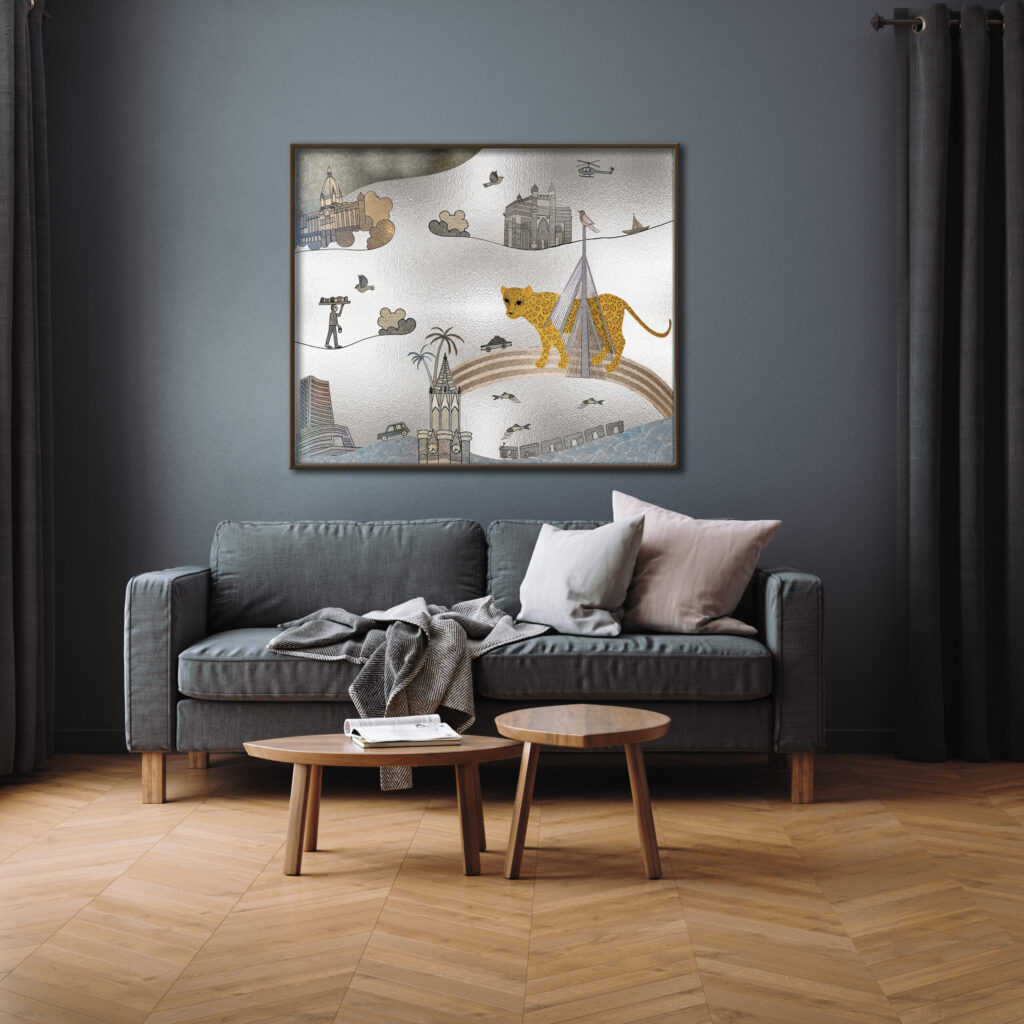
There’s a particular kind of disappointment that happens when a high-end interior is nearly complete.
The flooring is Italian marble. The joinery is custom. The lighting was specced by a consultant who flew in from Amsterdam. And then, on the feature wall, a large-format print from an online art marketplace, framed in a brushed brass profile that matches the door handles.
The room doesn’t work. Everyone in the room feels it. Nobody says why.
The art is why.
The Specific Ways Mass-Produced Art Undermines a Space
This isn’t about snobbery. It’s about how visual perception works in designed environments.
- Recognition deflates the effect. The brain is pattern-matching constantly. When a viewer has seen the same piece , or the same style of piece , reproduced across hotel lobbies, showrooms, and Instagram mood boards, the piece loses its capacity to surprise. That recognition is the opposite of what luxury design is trying to achieve.
- The scale problem. Mass-produced art is designed to sell at multiple sizes. Large-format reproduction pieces scale up the image but not the craft, brushstroke, texture, material depth. From across a room, a high-quality print can read plausibly. Up close, in a space where clients and guests are spending real time, the flatness is obvious.
- Proportional misfit. A good piece of art in a designed space has a specific relationship with the wall, the ceiling height, and the furniture below it. Mass-produced work doesn’t have that relationship, it’s a fixed product fitted into a space it wasn’t made for.
- Generic emotional register. Mass-produced art trends toward safe, inoffensive, widely appealing. That’s the product strategy, maximize the addressable buyer. But interiors designed for a specific client need emotional specificity. The art that sells to everyone communicates nothing to anyone.
Why High-End Projects in Particular Can’t Absorb This
At mid-market, mass-produced art is a reasonable solution. Budget constraints are real. Clients prioritize differently. A well-chosen print in a good frame is a defensible decision.
At the high end, the economics flip, and so does the logic.
High-end interiors are built on the premise that every detail was considered. When one element is generic, it doesn’t just underperform on its own terms , it retroactively undermines every element around it. Guests don’t say ‘the art is mass-produced.’ They say ‘something feels slightly off.’ That feeling spreads.
We’ve worked on projects where exceptional architecture, incredible materials, and months of careful design work were partially undone by the art program being treated as an afterthought. The client felt it even when they couldn’t articulate it.
The Budget Argument Doesn’t Hold Here
“We’ve spent everything else on the project” is the most common justification for placeholder art in high-end interiors.
It’s the wrong calculation.
The question isn’t how much of the total budget is left for art. It’s what is the marginal cost of getting the art right, and what’s the cost of getting it wrong.
In a high-value residential project, a bespoke art program for the three or four key spaces might represent 3–5% of project value. Replacing it with mass-produced work saves that percentage. The trade-off is a space that doesn’t achieve its brief, which means a portfolio image that doesn’t land, a client who doesn’t refer, and a project you don’t talk about.
When Mass-Produced Art Is Acceptable
There are cases where it’s appropriate:
- Curated original work at accessible price points. Emerging artists selling original work brings authenticity that reproduction can’t. This isn’t mass-produced art in the sense meant here; it’s collected art with genuine provenance.
- Temporary installations and staging. If a space is being photographed before the long-term art program is in place, mass-produced work as a placeholder is fine , provided it’s replaced before client handover.
- Supporting walls and secondary spaces. Not every wall art in every project needs a commissioned piece. A thoughtfully curated print in a corridor or secondary bathroom is a reasonable call. The problem is using the same logic on focal walls in primary spaces.
What High-End Projects Actually Require
- At minimum: original work by an artist whose practice is coherent, whose biography is real, and whose work has been specifically chosen for the space , not sourced from a ‘luxury interior’ filter on a stock art platform.
- Better: work commissioned directly from an artist, briefed to the space and the client, at a scale developed for the specific wall.
- Best: an integrated art program developed alongside the design , where the art is considered a design material, not a finishing product.
The distinction between these tiers isn’t just aesthetic. It’s how the space performs over time. It’s what clients say to their friends. It’s whether the photography gets published or doesn’t.
FAQ
1. Can mass-produced art ever work in high-end interiors?
Rarely, and only when it’s deliberately incongruous, used as a knowing reference or ironic contrast that serves a conceptual brief. Even then, the decision needs to be intentional, not economical.
2. How do you spot mass-produced art in a designed space?
Scale inconsistency, visible canvas texture that’s printed rather than painted, repeating edge patterns, and the quiet recognition that you’ve seen the same image somewhere before.
3. What’s the minimum art investment for a high-end residential project?
This depends entirely on the project scale and number of primary spaces. As a rule of thumb: if you’re not comfortable including the art budget in the total project quote you give a client, it’s probably not the right art for the project.
4. Should the architect or interior designer be involved in the art selection?
Yes, and ideally from early in the project, not after handover. Art chosen independently of the spatial design rarely integrates the way art developed alongside it does.