

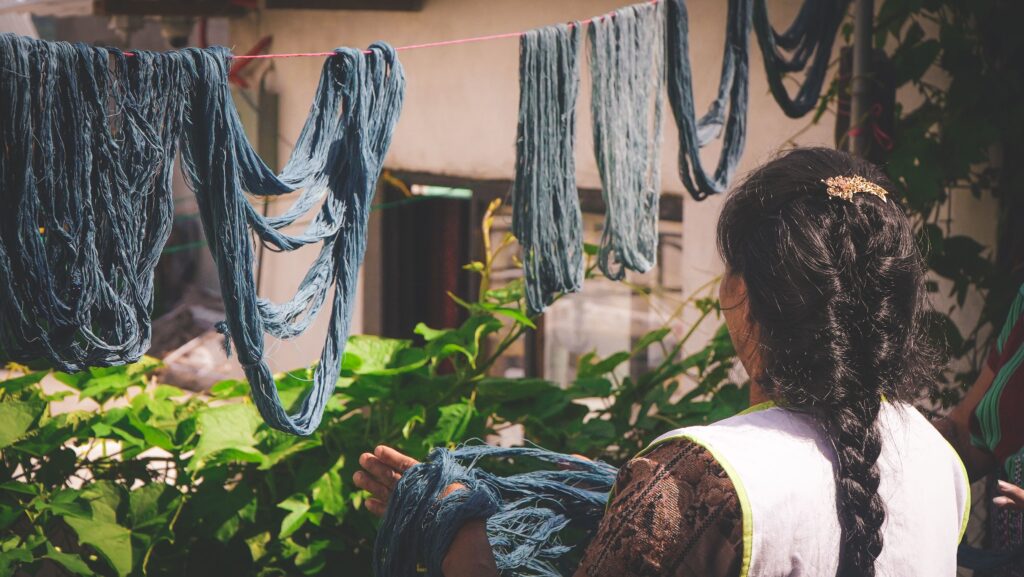
Indigo has travelled through Indian history as a dye, a commodity, a source of extraordinary craftsmanship and, at times, a cause for resistance. Perhaps that is why this blue has always felt so meaningful to me.
When people ask me why indigo feels so right for Baaya, I never quite know how short an answer they want.
The quick answer is that I love the colour.
The longer answer has very little to do with colour alone.
Indigo is one of those materials that becomes more interesting the closer you look at it. There is the blue we see, of course, but behind it are farmers, dyers, textile makers, trade routes, colonial plantations, protests and generations of knowledge about how to coax this extraordinary colour out of a plant.
At different points in history, indigo became so commercially valuable that it was referred to as “blue gold”.
But gold for whom?
That is where the story becomes complicated.
Before it was “blue gold”
India’s relationship with indigo began long before British rule.
For generations, dyers across the subcontinent worked with natural indigo to colour cotton and other textiles. Indian makers developed highly sophisticated dyeing, printing and resist techniques, and indigo-dyed cloth became part of a textile culture that travelled widely through international trade. The V&A notes that indigo was grown and used across many parts of South Asia before synthetic dyes began replacing natural indigo commercially in the late nineteenth century.
I find the process itself fascinating.
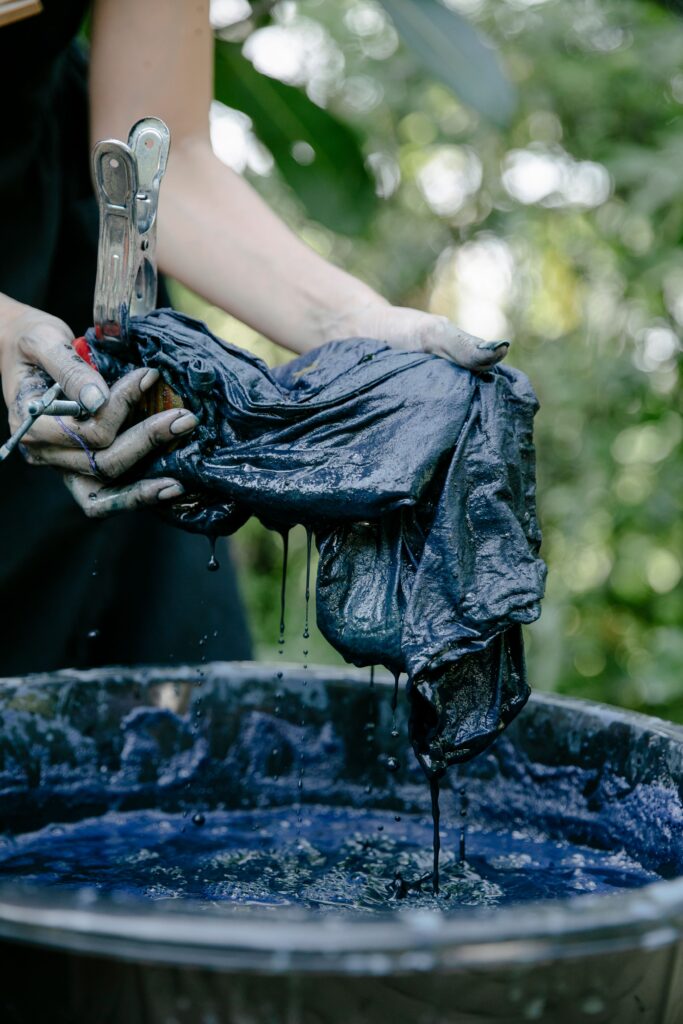
The plant does not present you with that spectacular blue in any obvious way. The colour has to be drawn out through a process of fermentation and dyeing. Cloth comes out of the vat looking very different and develops its blue as it meets the air.
There is almost something magical about it, except that calling it magic risks overlooking what it really is: knowledge.
Knowledge of material. Of timing. Of temperature. Of the vat. Of what the dye is doing even when the colour is not yet visible.
That is the part of indigo’s story I like to begin with, because colonial history can sometimes become so dominant that we forget there was an entire culture of making before exploitation entered the picture.
The British did not bring indigo to India.
They recognised its value.
And then they found a way to extract that value on a very large scale.
When blue became an instrument of power
By the nineteenth century, European demand had turned indigo into an enormously important commercial crop.
In parts of Bengal, cultivators were pressured into growing indigo under deeply unfair arrangements. Land that farmers could have used for crops they needed was tied instead to a commodity whose profits largely benefited European planters.
Eventually, people had had enough.
In 1859, cultivators in Bengal began refusing to sow indigo. What became known as the Indigo Revolt grew out of this collective resistance to exploitative plantation conditions.
That one act has always stayed with me.
They refused to plant.
It sounds so simple.
And yet, when a system depends on your labour, refusing to participate can become an extraordinarily powerful act.
Indigo appears again in another important chapter of India’s freedom movement.
In 1917, Gandhi travelled to Champaran after hearing about the conditions faced by indigo cultivators there. He investigated the grievances of farmers forced into the tinkathia system, under which part of their land had to be devoted to indigo cultivation. By August 1917, the Champaran Committee had agreed to abolish the system.
So here was this beautiful blue, desired across the world, sitting at the centre of a very ugly question:
Who actually benefited from its value?
Beauty has never existed separately from labour
Perhaps this is why I hesitate when we describe craft only through words like beauty, heritage and tradition.
They are all true. But they are incomplete.
Behind most things we admire is labour.
Someone grew the material.
Someone gathered it.
Someone understood what to do with it.
Someone learnt the technique from somebody before them.
Someone spent hours making the thing we eventually encounter as a finished object.
Indigo makes that relationship unusually visible because its history contains both extraordinary craftsmanship and extraordinary exploitation.
And I don’t think one story should erase the other.
We should be able to admire a beautifully dyed textile and still ask who grew the indigo.
We should be able to celebrate traditional knowledge while acknowledging the economic systems that have shaped it.
We should also be careful not to turn the Indigo Revolt into the entire identity of indigo in India. Its story is much older and much wider than colonialism.
That complexity is exactly what I find compelling.
Indigo has been a material of craft, a global commodity, a livelihood, a site of exploitation and a reason for resistance.
One blue. Many lives.
Why indigo at Baaya?
This is where the story becomes personal for me.
At Baaya, we work with Indian art and craft traditions in contemporary contexts. And over the years, I have realised that the most interesting part of that work is rarely just the visual language.
It is everything sitting behind it.
The history of a technique. The hand that understands the material. The knowledge that cannot be learnt by simply looking at the finished object. The question of whether someone practising that craft today can actually make a good living from it.
We talk a great deal about preserving craft.
I increasingly feel that preservation is not enough.
A tradition can be beautifully documented and still disappear.
An object can sit safely in a museum while the knowledge needed to make it vanishes outside its walls.
For a craft to remain alive, there has to be a reason for someone to continue practising it. There must be dignity in the work, curiosity around it, new opportunities and, very simply, a market.
That is what makes indigo feel relevant to Baaya beyond its colour.
Its story reminds us that materials are never just materials. Their value depends on people. And the people who create that value need to remain visible in the story.

So, why blue?
Because it is beautiful.
But also because it isn’t innocent.
Indigo carries the intelligence of the dyer and the labour of the farmer. It carries centuries of textile knowledge. It carries the hunger for a commodity that became valuable enough to be called “blue gold”. It carries exploitation, refusal and resistance.
And somehow, after all of that, it is still simply this astonishing blue.
Perhaps that is what I like most about it.
Heritage does not have to be polished into a perfect story before we can value it. In fact, I think the opposite is true.
The more honestly we understand where something comes from—who made it, who profited from it, who fought over it, and who continues to carry its knowledge—the more meaning it acquires.
So when I see Baaya’s indigo, I don’t think only of a brand colour.
I think of a colour that has lived many lives.
And of all the hands that have carried it from one to the next.