

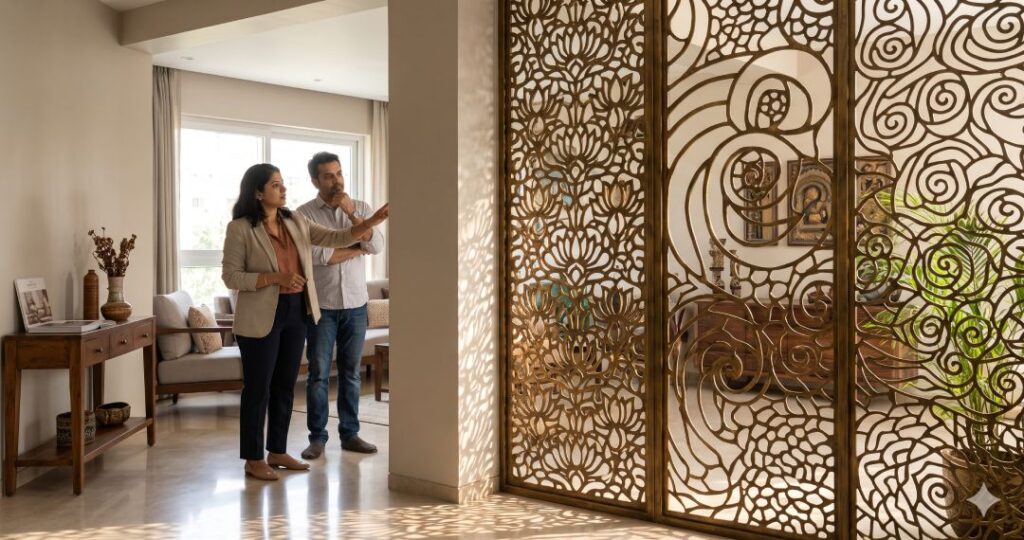
Some boundaries work best when they remain open. A jali can suggest a division between spaces while allowing glimpses through it. Its pattern becomes part of the architecture, and the changing relationship between solid material and open space gives it a distinctive presence. Brass jali panels offer a way to explore this balance in contemporary homes, luxury hospitality spaces, and workplaces.
Use a jali to define space gently
In an open-plan home, a decorative screen may help distinguish an entrance foyer from a living area without creating a full visual barrier. Within bespoke residential interiors, a brass jali partition can frame a seating zone, accentuate a pooja corner, or mark a transition between different uses. The right application depends on the layout and the level of separation required. A decorative jali should not be assumed to provide acoustic privacy, security, or the performance of a solid wall. Define its purpose clearly before choosing the design.
Choose the pattern according to the view
A pattern that looks intricate close up may read quite differently across a room. Consider what should remain visible through the panel and where people will stand or sit. A more open design creates a lighter spatial experience than a denser arrangement. Baaya’s Brass Golden Spiral Jali explores crisp geometric rhythm, while the Dhokra Lotus Foliage Jali takes inspiration from organic, hand-cast forms. Together, they offer distinct starting points for a conversation about proportion, texture, and character.
Think about light and the background
The space behind the jali affects how clearly its pattern is perceived. A calm, uncluttered background—or a thoughtfully paired decorative wall panel can make the silhouette more legible, whereas a visually busy setting may compete with it. Depending on natural daylight and nearby statement lighting, the perforated pattern will also cast shifting shadows onto adjacent floors and walls. Assess the composition under both daytime and evening conditions before finalising placement.
Discuss finish and maintenance
Ask how the selected brass finish is expected to evolve over time and what care it requires. Some interior projects favour a living finish that develops a warm patina, while others call for a lacquered surface with a more consistent appearance. The surface treatment and maintenance approach should be agreed upon for the specific piece and environment.
Resolve fixing and safety requirements early
Dimensions, weight, support, edges and installation access all need attention. If the panel will be used in a location with safety or regulatory requirements, the project team must verify that the proposed design is appropriate. A decorative screen should never automatically be treated as a compliant balustrade or protective barrier. Explore Baaya’s Signature designs for crafted surface and screen ideas.
For a brass jali enquiry, email info@baayadesign.com with dimensions, site photographs and the intended application.