

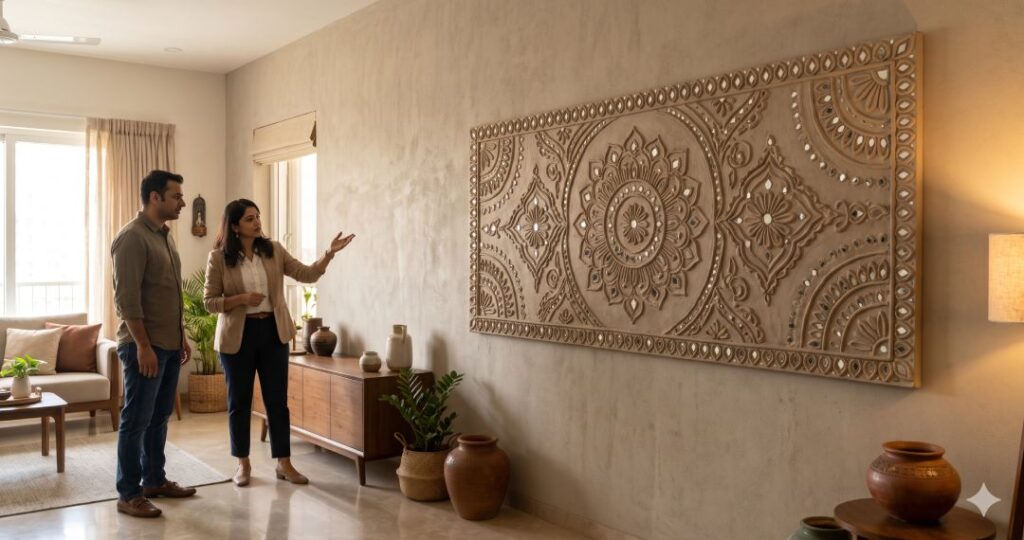
A wall does not need a bold colour to become memorable. Sometimes, relief, shadow, and small moments of reflection create all the interest it needs. Lippan art brings these qualities together. Rooted in the mud-and-mirror traditions of Kutch, this tactile craft offers a distinctive dialogue between an earthy matte surface and glinting reflective detail. In bespoke residential interiors, that relationship becomes an expressive starting point for a thoughtful focal wall.
Appreciate the craft, then consider the setting
Traditional Lippan work has a strong connection to the vernacular architecture and decorative practices of Kutch. Contemporary interpretations bring the craft into refined formats suited to modern apartments and villas. Materials, substrates, and relief techniques may vary between works, so ask how a particular piece has been constructed rather than assuming all Lippan wall art uses an identical process. Understanding how the artwork is made helps you select and care for it with greater confidence.
Give texture space to be seen
Lippan art works particularly well where its dimensional surface is allowed to hold quiet attention. Consider an entrance foyer, a wall beside a main seating area, or a corridor vista where people can appreciate the relief at different distances. Avoid crowding the wall with too many detailed accessories or competing brass jali panels immediately beside it. A restrained setting allows the hand-sculpted contours and mirror inlays to stand out naturally.
Choose the composition for the architecture
The craft does not dictate a single visual style. A composition can be geometric and structured or fluid and organic, intricately detailed or calm and spacious. Baaya’s Pushpa Varsha, for example, interprets the poetic idea of a shower of flowers through handcrafted Lippan wall art. Think about how the artwork’s proportions relate to the architecture much like evaluating scale between decorative wall panels and murals, a wide horizontal dining wall and a narrow vertical niche call for different compositional balance.
Consider daylight and evening light
Mirror details respond dynamically to what they reflect, while raised mud-work surfaces reveal themselves through shadow. Observe the intended wall at different times of day to see how natural light grazes the relief. If you plan to pair the piece with architectural fixtures or statement lighting, test the angle before fixing its final position. The goal is to highlight the tactile texture comfortably without creating harsh glare from the mirrors.
Confirm suitability and care
Before commissioning or hanging a piece, ask about the backing board, total weight, concealed mounting method, and recommended dusting or cleaning process. For humid zones, semi-outdoor verandahs, or high-traffic walls exposed to frequent contact, obtain specific guidance on protective sealants and finishes. Explore Baaya’s wall art and murals to discover contemporary Indian craft expressions tailored to modern architecture.
Interested in Lippan art for your home? Send wall photographs, dimensions and your project location to info@baayadesign.com.