

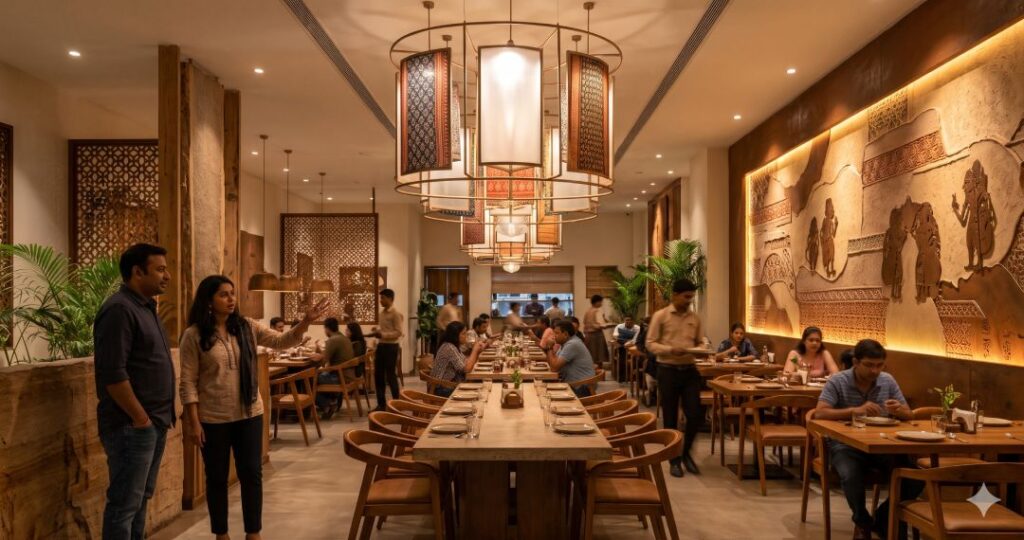
A restaurant begins communicating before the first dish reaches the table. The entrance, materials, artwork, and lighting all offer immediate clues about the dining experience ahead. Together, they can suggest warmth, informality, celebration, or a deep connection to a particular place. For restaurant owners and designers working on luxury hospitality spaces, custom restaurant art and bespoke lighting provide a tangible way to express that identity.
Turn the concept into a clear creative brief
Start with what gives the restaurant its character. Is the menu rooted in a specific region? Does the concept bring together different culinary traditions? Is there a family history, landscape, or local craft practice that informs the experience? Move beyond broad words such as “luxurious” or “authentic.” Specific cultural and material references give an artist or designer something meaningful to interpret. The result need not illustrate the menu literally material, pattern, and form can carry a brand story with far greater subtlety.
Choose where the story should be most visible
Not every zone in a dining room needs the same visual intensity. An entrance installation or crafted screen—such as perforated brass jali panels can establish the first impression. A sculptural feature above communal seating can define the centre of the room, while smaller artworks or tactile decorative wall murals reward closer attention in quieter booths. Consider how all elements relate across the floor plan; one clear focal point is often more memorable than several competing features.
A Baaya example: Forefathers, Hyderabad
For Forefathers, a South Indian fusion restaurant in Hyderabad, Baaya developed a bespoke light installation that brought regional craft references into a contemporary dining setting. The project incorporated authentic materials and techniques including Telangana dhurries, Telia Rumal, leather shadow puppetry, handwoven textiles, frosted stained glass, and Corten steel. This offered a layered material expression of the restaurant’s concept: a conversation between regional traditions and a modern culinary experience. Explore the Forefathers project to see the installation in its setting.
Balance visual impact with the dining experience
Decorative fixtures must work seamlessly alongside the restaurant’s wider architectural lighting plan. Guests need to read menus clearly, see the colours of their food accurately, and engage comfortably with one another, while staff require practical illumination for smooth service. Much like planning statement lighting in residential settings, a sculptural restaurant piece should be coordinated with functional layers rather than expected to resolve every lighting need alone. Review glare, table reflections, and dimming transitions across lunch and evening service times.
Design for everyday operation
Early in the design stage, discuss cleaning access, ongoing maintenance, ceiling suspension loads, and proximity to kitchen heat, steam, or food preparation areas. For commercial hospitality projects, all material, fire-safety, and electrical specifications should be reviewed by the relevant project consultants. A successful custom installation must work effortlessly for the operational team as well as delight the guest.
Begin while the interior is still taking shape
Early collaboration gives custom art and lighting a much stronger relationship with the architecture, ceiling services, and spatial flow. Explore Baaya’s lighting designs
to see how handcrafted forms translate into architectural settings.
Developing a restaurant or hospitality project? Send your concept, location, floor plan and target opening date to info@baayadesign.com to discuss a bespoke approach with Baaya.