

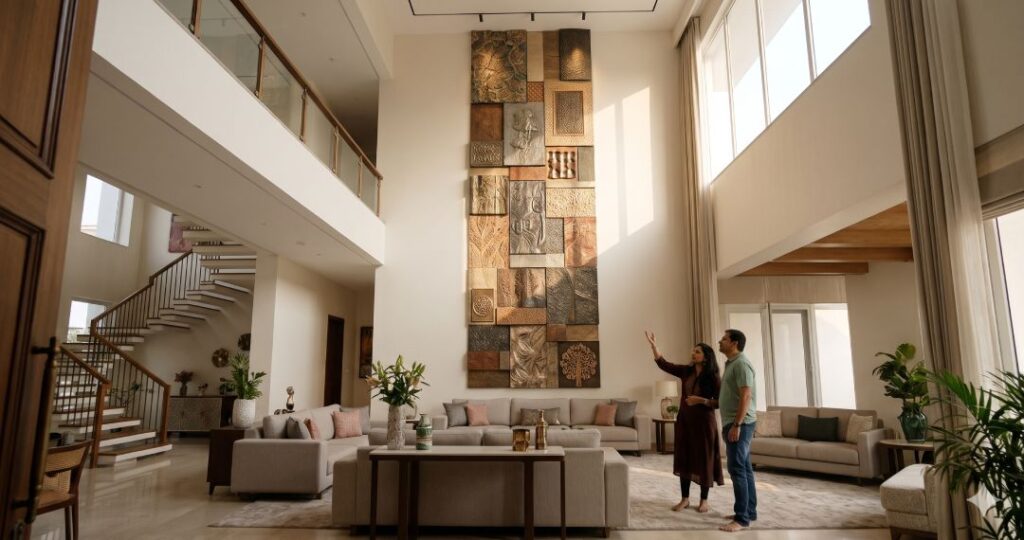
A double-height living room offers an unusual canvas. Its walls extend beyond the scale of everyday furniture, creating space for an artwork that can be experienced from across the room, from a staircase, or from an upper landing. That opportunity also creates a challenge: a piece chosen only to fill the wall may feel disconnected from the people using the space. In bespoke residential interiors, the aim is to connect the room’s generous proportions with a composition that feels intentional.
Start with the main viewing positions
Identify where the double-height wall art will be seen most often. The view from the entrance foyer may be very different from the perspective on the main sofa, while an upper-level corridor may reveal tactile details that are difficult to appreciate from below. Use photographs or architectural elevations to test these sightlines. They will help determine where the composition should begin, where its strongest focal elements should sit, and how much breathing room should remain around it.
Think beyond one oversized rectangle
A large framed work is one option, but tall walls can support far more nuanced approaches. A vertical composition may reinforce the height of the architecture, while a multi-panel grouping can create visual rhythm across a wide surface. A material-rich mural or textured Lippan wall art can also bring sculptural depth to an otherwise restrained room. The choice should follow the architecture and desired mood, rather than assuming a tall wall always demands a single, oversized canvas.
Connect the artwork to the room below
Furniture establishes the human scale of the interior. Consider how the lower edge of the installation relates to a sofa, console, or seating group, even as the artwork rises well above them. Anchoring the lower elements creates a natural visual bridge to the occupied zone of the room. Because there is no universal hanging-height rule for a double-height composition, test the proportions in a scaled elevation drawing first.
Plan lighting alongside the art
A tall installation requires a different illumination strategy than a conventional painting. Discuss beam angles, vertical spread, and potential glare with your lighting designer, especially if the wall sits near dramatic statement lighting. Also consider how fittings will be accessed for future maintenance. Above all, the artwork should remain visually coherent in natural daylight, not only under dedicated evening fixtures.
Resolve installation access early
Large-scale wall art requires clear technical planning around wall construction, load-bearing fixing points, and site access. Coordinate delivery routes, on-site assembly needs, and scaffolding requirements before flooring and furniture are fully installed. Explore Baaya’s bespoke work including our custom residential art installations to see how handcrafted art can be developed around ambitious architectural settings.
Planning art for a double-height living room? Share an elevation, wall dimensions and room photographs with info@baayadesign.com to discuss the possibilities.